Despite it's inherently timeless nature, I'm always surprised when music meant for another time and another place can traverse almost a century of culture shifts and make an impact on my life. In 1926, Mort Dixon and Ray Henderson penned the lyrics to the folk classic "Bye Bye Blackbird" and throughout the following eighty years, countless artists, from Ella Fitzgerald to Miles Davis to Liza Minnelli and, later, even Ringo Starr and Joe Clocker (also brethren via "With a Little Help from My Friends") would record this song in their various divergent styles.
The most memorable version for me, though, was never recorded and only passed down by word of mouth. In fact, until this week I was sure that "Bye Bye Blackbird" had just been a creation of my mothers own imagination. It was my bedtime song, for more years than I can remember...at least until I was eighteen...er, I mean...uh...eight.
It has been years since I thought about the song, but as my parents prepared to become "21st Century Pioneers," and achieve the dream -- nay, the right -- of Manifest Destiny set out by our great nation's forefathers by moving to Ye Olde Weste (aka - Santa Fe, New Mexico), I found myself meandering in a dense forest of childhood reminiscences. Disney movies, bedtime stories, The Beatles, nightlights...all things that were most influential. As the hour of my parents' departure approached, the melody my mother used to sing to me as she put me to bed popped into my head, but I struggled to recall the words that I hadn't heard in so long. I remembered "blackbird," but my mind could not stop wandering to the Beatles' song.
"What was that song, mom?..."
"'Bye Bye Blackbird'," she jumped at my question, uncannily knowing exactly which "that song" I had been thinking about.
And immediately the words came back, fitting right into the melody.
Pack up all my cares and woes,
Here I go,
Flying low,
Bye bye blackbird,
Where somebody waits for me,
Sugar's sweet,
So is she,
Bye bye Blackbird.
No one here can love or understand me,
Oh, what hard luck stories they all hand me,
So, make my bed and light the light,
I'll be home late tonight,
Blackbird, bye bye.
So many feelings -- of the warmth of my bed, of childhood, of not wanting my parents to leave, of fear -- came flooding along with the lyrics. The latent memory of the song, and of its sole association for me, once so deeply embedded in the recesses of my mind, were now vividly at the forefront. And there they remain. I walk around all day, humming whistling openly singing my mother's melody. No matter how many crackly old or sparkly new versions I hear, Ella and Miles and Ringo cannot begin to erode the etching of that one melody. Every note of theirs that deviates from hers is a sore thumb. They might as well be singing off key.
There are other songs that hold a special place in my life ("And So It Goes" by Billy Joel) and allow me access to emotional depth like few other things do, but they often come and go as I grow accustomed to the associations they hold for me. "Bye Bye Blackbird," though, will always symbolize something meaningful, not the least of which is my earliest childhood memories and, in turn, my innocence.
Tuesday, September 16, 2008

Tuesday, September 2, 2008
Kirtan
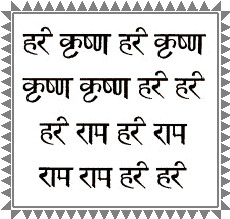
A month ago, as the sun set over the Catskills and yielded to the moonless night of a new moon, I sat (not very comfortably) on a hardwood floor in a small capsule of Hinduism. The Ashram was hot, having just gotten its first relief from the beating sun since early the previous morning, and the flies threw themselves against the glass walls in desperate but futile attempts to escape the same baking capsule that I had traveled two hours to enter.
As we stepped into the room, the Swami -- sitting in Lotus position at the front, behind him an elaborate shrine of gold and candles in honor of the blue-skinned Krishna, the monkey-faced Hanumanta, and the long-nosed Ganesha -- began to chant. At first it was a stereotype: "Om..." He and the other Yogis in the room held the mantra for what could have been a full minute. "Om..." again, and this time the cynicism that had arisen at first hearing the oft-misused mantra melted away and I found myself eagerly, naturally letting my voice out to join in the third repetition. "Om..." as I let the Manhattan air out of my lungs and breathed in slowly, deliberately, the warmth and welcoming scents of the Ashram. I closed my eyes to the flashing neon and whizzing subways, and opened them again to a dimly lit temple, filled with lotus sitting seekers, like myself, secluded on a ranch in upstate New York. Once the chanting started, even smells and sights fell by the wayside.
Indian mantras both fascinate and intimidate me. As a drummer, the odd cycles of ancient Eastern music are completely unknown. Several years ago I attended a performance by Anoushka Shankar, and she attempted to explain cycles of fifteen and eleven, which were held perfectly by her tabla player. The tablas have always been a looming interest of mine -- something I'd love to learn but that seems inaccessible and beyond my musical grasp nevertheless. My drum professor in college told me that indigenous Indian tribes often do not allow young musicians to play even a single note until they can clap and vocalize a year's worth of exercises. The logic, which is just as true for Western drumming, is that once you can vocalize a rhythm it can be easily played with the hands.
It is with this knowledge that I remain an admirer from afar of tablas, though someday I will undoubtedly muster the courage to give it a shot.
I digress...
Mantras have been chanted for thousands of years, and when the harmonium ushered in the beginning of Kirtan in the glass walled temple, I felt transported. Not to any one particular time, but rather to no time at all. The "healing power" of Kirtan is often speculated on, often hypothesized about. And from a Western perspective it's hard to believe that the simple speak-singing of words would have any sort of power at all, be it supernatural or personally spiritual. The notion might seem silly, but the act of singing words -- words that I have a gist of, but did not and do not understand the true meaning of -- brought me a warmth and peace that I haven't felt for almost a decade. I may only be twenty-three, but I've had my share of spiritual triumphs and disappointments. I have not had a triumph like this one since I was just a kid, when most of my friends and I grew scientific minds and rejected our parents' representations of One God in an organized religion.
I know I tend to use hyperbole as the norm in my writing, but I could not possibly overstate my first experience with Kirtan. Music moves me often -- lyrics give me chills, minor chords can affect me, and upbeat tempos can make me feel just that -- but rarely does music give me warmth. The droning hum of the harmonium was hypnotizing and had the group of us swaying from side to side, clapping, and slapping tambourines and shakers with the rhythmic cycle. Over the following two days we would repeat this performance three more times after meditation, and each time, as I got more comfortable with singing in Hindi chanted melodies, I also felt more able to connect to what we were saying. This is not to say that my first experience with Hinduism "converted" me to the world of polytheistic mysticism as a belief system, but the power that radiates from the chants is real, and I've felt it in every experience since my first.
Western religious chanting, or "praying," has developed the distinct air of obligation. Words without meaning, memorized to appease a vengeful and fearsome and awesome God who will otherwise damn you to an eternity in the pits of Hell or leave you out of the Book of Life in the year to come. Going to a synagogue or church does not inspire me, nor does it inspire many of the people that I know. Of the millions and billions of religious denizens on this planet, I would like to know how many truly love their God(s), how many fear Them (many may feel both), and how many simply believe for the sake of believing, out of nothing more than guilt or obligation.
I would like to challenge everyone who reads this to try chanting, though I know that it is not something that will enlighten the masses, especially given the heavy skepticism with which Eastern ideas are often met in our society. I can only say that in a city that often overwhelms me with negativity and noise, I found a small refuge in Woodbourne, New York -- and then another at the Sivananda Yoga Center in that city itself -- where I can go to block it all out and get in touch with something a bit more enlightening.
Tuesday, August 19, 2008
LeRoi Moore
I've just heard the crushing news that Dave Matthews Band's saxophonist, LeRoi Moore, has died from his injuries sustained in late June from an ATV accident. I saw DMB just a few days later at Rothbury and in the presence of the great Jeff Coffin, brushed Roi's absence aside with the assumption that I'd see the band again at some point in the future, and he would be with them then. It was a sad moment, seeing that CNN Breaking News headline with Roi's name in it, and the shock has not yet worn off to allow the full effect of what we've lost to sink in.
Years ago, during high-school chemistry and the height of my crazed DMB fandom, a close friend and I lamented the release of Everyday as a sign to the band's imminent breakup. In the wake of the famed Lillywhite Sessions/The Summer So Far debacle of 1999-2001, our fears centered around Dave's obvious and well-publicized alcoholism and depression, which was all too painfully reflected in his songwriting. Over the years my devotion has mellowed, but my interest and love of Dave Matthews Band's music has not. I callously tease friends who have maintained their undying loyalty, but really I am jealous that I no longer feel as drawn to any music as I once did to Matthews'.
Roi was the epitome of a drummer's saxiphonist. If we're being completely honest, he was much more than a bass, baritone, tenor, alto, and soprano saxiphonist -- he also played the flute, pennywhistle, and bass clarinet. Partially through his own doing and partially through the mastery that is Carter Beauford's drumming, Roi developed an uncanny ability over the past seventeen years with DMB to write horn lines that were both appropriately melodic and subtly percussive, for example on "Stay (Wasting Time)" (Before These Crowded Streets, 1998). Even more percussive were his solos, with which Beauford was constantly artfully matching his syncopated hi-hat rhythms and off-beat snare hits, and which -- in true jazz tradition -- often playfully referenced other songs and solos.
I'd like to say that I'll make good on my self-assurance at Rothbury that I'll see DMB again, but now it will never be possible. No matter how many tours the band goes on or how many replacements they try to fit in, today is the day that Dave Matthews Band is no more, and it's something from which I do not feel at all ready to move on. I wish I had seen the band one week earlier, and what was briefly known as "the best tour since the fabled 2000" is now irreparably marred. As I write this, DMB has taken the stage at the Staples Center in Los Angeles and is honoring their friend, with Coffin filling his spot at stage right now indefinitely. The robust saxman, always shaded and smiling, an almost two-decade fixture on the Dave Matthews Band stage, has left in his wake an unfillable void. And while I'm sure his bandmates will toil for years to come to recreate the magic he brought to the studio and the stage, and fans will argue unceasingly as to whom might best replace the beloved Roi, DMB will never be the same again.
**UPDATE** (8/20/2008)
In honor of the late great LeRoi Moore, here are my Top 5 Roi Live and Studio Tracks from 1991 - 2008. They're all live and perfectly embody his soloing and line-writing styles.
Studio:
1. "#34" - Under The Table And Dreaming (1994)
2. "Spoon" - Before These Crowded Streets (1998)
3. "#41" - Crash (1996)
4+. "Kit Kat Jam," "Captain," "Raven," "Grey Street" - Busted Stuff (2002)
5. "Sweet Up And Down" - The Lillywhite Sessions/The Summer So Far (1999/2000)
Live:
1. "Stay (Wasting Time)" - Listener Supported (1999)
2. "Lie In Our Graves" - Live At Red Rocks 8.15.95 (1997)
3. "What Would You Say" - Live Trax Vol. 2 (2004/09/12 Golden Gate Park) (2004)
4. "So Much To Say" --> "Anyone Seen The Bridge" --> "Too Much" - The Central Park Concert (2003)
5. "Pantala Naga Pampa" --> "Rapunzel" - The Gorge (2004)
Years ago, during high-school chemistry and the height of my crazed DMB fandom, a close friend and I lamented the release of Everyday as a sign to the band's imminent breakup. In the wake of the famed Lillywhite Sessions/The Summer So Far debacle of 1999-2001, our fears centered around Dave's obvious and well-publicized alcoholism and depression, which was all too painfully reflected in his songwriting. Over the years my devotion has mellowed, but my interest and love of Dave Matthews Band's music has not. I callously tease friends who have maintained their undying loyalty, but really I am jealous that I no longer feel as drawn to any music as I once did to Matthews'.
Roi was the epitome of a drummer's saxiphonist. If we're being completely honest, he was much more than a bass, baritone, tenor, alto, and soprano saxiphonist -- he also played the flute, pennywhistle, and bass clarinet. Partially through his own doing and partially through the mastery that is Carter Beauford's drumming, Roi developed an uncanny ability over the past seventeen years with DMB to write horn lines that were both appropriately melodic and subtly percussive, for example on "Stay (Wasting Time)" (Before These Crowded Streets, 1998). Even more percussive were his solos, with which Beauford was constantly artfully matching his syncopated hi-hat rhythms and off-beat snare hits, and which -- in true jazz tradition -- often playfully referenced other songs and solos.
I'd like to say that I'll make good on my self-assurance at Rothbury that I'll see DMB again, but now it will never be possible. No matter how many tours the band goes on or how many replacements they try to fit in, today is the day that Dave Matthews Band is no more, and it's something from which I do not feel at all ready to move on. I wish I had seen the band one week earlier, and what was briefly known as "the best tour since the fabled 2000" is now irreparably marred. As I write this, DMB has taken the stage at the Staples Center in Los Angeles and is honoring their friend, with Coffin filling his spot at stage right now indefinitely. The robust saxman, always shaded and smiling, an almost two-decade fixture on the Dave Matthews Band stage, has left in his wake an unfillable void. And while I'm sure his bandmates will toil for years to come to recreate the magic he brought to the studio and the stage, and fans will argue unceasingly as to whom might best replace the beloved Roi, DMB will never be the same again.
**UPDATE** (8/20/2008)
In honor of the late great LeRoi Moore, here are my Top 5 Roi Live and Studio Tracks from 1991 - 2008. They're all live and perfectly embody his soloing and line-writing styles.
Studio:
1. "#34" - Under The Table And Dreaming (1994)
2. "Spoon" - Before These Crowded Streets (1998)
3. "#41" - Crash (1996)
4+. "Kit Kat Jam," "Captain," "Raven," "Grey Street" - Busted Stuff (2002)
5. "Sweet Up And Down" - The Lillywhite Sessions/The Summer So Far (1999/2000)
Live:
1. "Stay (Wasting Time)" - Listener Supported (1999)
2. "Lie In Our Graves" - Live At Red Rocks 8.15.95 (1997)
3. "What Would You Say" - Live Trax Vol. 2 (2004/09/12 Golden Gate Park) (2004)
4. "So Much To Say" --> "Anyone Seen The Bridge" --> "Too Much" - The Central Park Concert (2003)
5. "Pantala Naga Pampa" --> "Rapunzel" - The Gorge (2004)
Thursday, August 14, 2008
All Points West? More like South...
Those of us with festival experience – or should I say real festival experience – were wary about what to expect from the inaugural “All Points West Music and Arts Festival” in Jersey City , NJ
Bands were given only one hour to play (plus or minus fifteen minutes), with a half-hour between acts for breaking down and setting up, which was more than enough time for the lower-tier of performers (see examples below). For the better bands (Radiohead aside, whose set ran for over two hours, but was still over in time for the early bird special at 11:00pm, whereas most festivals run until 3:00am), the set times were ludicrously short. Treating The Roots like an opening band by putting them on stage during the waning daylight hours of 7:15pm to 8:15pm is simply inappropriate. The Roots open for no one! They were barely warmed up by the end of the hour and seemed to have at least two more hours of performance left, since that's what their normal shows entail. They are one of the premier musical performers on today's scene and are widely accepted as the greatest live hip-hop band EVER. And All Points West relegated them to one hour, which led immediately into the 8:30pm Radiohead set. I was just as excited as anyone there to see Radiohead play, but making them the only band that plays for longer than one hour is just disrespectful to the other worthy acts. A more apt name for the APW would have been "Radiohead featuring the All Points West Music and Art Festival," and not the other way around. They rightfully received top billing, but at the expense of a longer Roots performance. If acts were overlapping all day, as they are bound to do at festivals, why not give people the option of staying an extra hour with The Roots and cutting down the crowd for Radiohead? I still would've gone and paid homage to the musical gods, but many would have opted to stick with the kings of hip-hop.
Despite all of the unfestive logistical nightmares, the arts part of the “music and arts” festival was a smashing success. The tone that organizers were going for (AEG Live of Coachella and Rothbury fame) was one of environmental responsibility, a theme that I didn’t even know about until after the festival was over and Nate Chinen of the New York Times revealed that All Points West was “expressly full” of “environmental selling points.” All bitterness aside, that green goal, while virtually invisible and unpromoted, is what led to the relaxed and entertaining atmosphere inside the festival. There were water games and modern abstract sculptures galore, and before 5:00pm rolled around, when thousands of people started filing in, there was room to play frisbee and walk calmly from stage to stage. And it's a good thing, because it was impossible not to want to wander.
The music was the most perplexing aspect of the entire affair. Saturday consisted of a few great acts (Radiohead, The Roots, Animal Collective, Sia) interspersed with a majority of mediocre-at-best artists (K'Naan, Nicole Atkins, Chromeo), which were all painfully bogged down by some that were simply unbearable (The Felice Brothers, Exit 105, Your Vegas). The former musicians were all saved for evening slots, which explains the mad rush to get in. The latter two groups, however, were arranged in ascending order by quality (because first is the worst), leaving that calm and pleasantly festivalish part of the day filled with lots of background music, but essentially devoid of any band truly worth sticking around for...hence my gratitude at the plethora of activities (frisbee, photography, art exploration, etc.) at my disposal. In true "festival" form, the pre-evening day was a lovely refuge from the usual hustle and bustle of living in or just outside of
Day and night at All Points West were polar opposites. They were like...well...like night and day. Once the front runners showed up -- that is, those who paid $110 to go to a festival and just show up for the headliners -- All Points West went South. Not musically, of course, because Radiohead and The Roots were in the line-up, but the calm, happy-go-luckiness of the first five hours vanished in a flash of Prada bags (did I just date myself, or are those still popular?) and Dolce and Gabbana sunglasses. Call me cynical (I am) or just plain bitter (I am NOT, you son of a bitch), but those New Yorkers turned my festival into a jam-packed concert, complete with requisite dirty looks, pushing, rubbing, yelling, and "fuck-off"s.
At other festivals, the crowds exude positivity (see my posts about Rothbury) and consideration for each other. Just by attending a festival together, all those in attendance foster a sense of community and belonging that only music can create. I did not find this at All Points West, and I would argue that any festival held in
Review: Lykke Li - Youth Novels (2008) - - SCANDIMANIA!
As published on the Princeton Record Exchange Blog:
Fifty years after the “British Invasion,”America Scandinavia . I’m From Barcelona (but actually from Sweden
Fifty years after the “British Invasion,”
Li was born in
As many of my peers, I have an inexplicable soft spot for Scandinavian indie music. On paper, a lot of it can be written off as a collection of strange noises and novelty for novelty’s sake (see Sigur Rós), but in practice it gets me every time. Lykke Li fits this formula to a tee. Despite everyone’s assertions of its genius, I couldn’t get into Amy Winehouse’s Back to Black, but Li has captivated me with a lighter version of a familiar sound. The hip-hop, R&B, and soul influence are all visible, but it is her lightened, innocent vocals that really make it worth listening to. She delivers each line, whether heartwarming or heartwrenching, with equal sincerity and maturity, two qualities that will no doubt grow as Li leaves her musical adolescence behind.
Monday, August 11, 2008
Dear Kings of Leon...
I'm sorry that I've balked at the very mention of your name since Bonnaroo 2007. Playing before The Police was a tough spot to be in, and the pressure of the massive crowd must have been simply too much for you to bear, which explains why you put on such a boring power-pop performance on that fateful June day. I vowed to never even consider seeing you again. I swore to myself that I'd go out of my way to discourage my friends from even considering attending one of your shows. And, when I found out that you were playing at All Points West on Saturday, August 9, I took it upon myself to ensure that everyone that asked my advice knew to stay away from the likes of you.
I'm sorry.
Saturday was a beautiful day, with the Statue of Liberty andNew York City
I'm sorry.
I never even gave you a chance. Sure, I tried your studio stuff and I don't like it that much, but everyone knows, most of all me, that bands are different live. And lots of people seem to like you. In fact, other than Animal Collective, you were the first band that really packed the field. That's rarely how I measure a band, but in this case it was surprisingly accurate. After a day of relatively unimpressive bands, you got me to turn my head. Your drummer, tastefully interspersing cowbell hits with tom fills in the middle of a verse, really grabbed me and put me on my ass, and your bassist not only drove the song but steered me to a nice spot in the grass where I could marvel and eat my $10 hot dog.
So, Kings of Leon, I'm sorry for my doubt and unfounded hatred over the past year. I may be late on the bandwagon, but "Sex On Fire" really, really, reallyreallyreally rocks hard, and I'd be a fool to deny it just because of pride. When you come back toNew York
I'm sorry.
Saturday was a beautiful day, with the Statue of Liberty and

I'm sorry.
I never even gave you a chance. Sure, I tried your studio stuff and I don't like it that much, but everyone knows, most of all me, that bands are different live. And lots of people seem to like you. In fact, other than Animal Collective, you were the first band that really packed the field. That's rarely how I measure a band, but in this case it was surprisingly accurate. After a day of relatively unimpressive bands, you got me to turn my head. Your drummer, tastefully interspersing cowbell hits with tom fills in the middle of a verse, really grabbed me and put me on my ass, and your bassist not only drove the song but steered me to a nice spot in the grass where I could marvel and eat my $10 hot dog.
So, Kings of Leon, I'm sorry for my doubt and unfounded hatred over the past year. I may be late on the bandwagon, but "Sex On Fire" really, really, reallyreallyreally rocks hard, and I'd be a fool to deny it just because of pride. When you come back to
Wednesday, August 6, 2008
gigs Gigs GIGS!
Just a little administrative update -- from now on I'll be listing my gigs along the right side of the blog, complete with location and time. I hope to see everyone out there on the battlefield, supporting my every move and reveling in my percussive prowess.
Much thanks and love,
Jake
Much thanks and love,
Jake
Subscribe to:
Posts (Atom)